Rogue Movers Are Real: Why Protecting Yourself Starts With Doing Your Homework

Visual Infographic
Click on the image below to expand and view full size infographic.
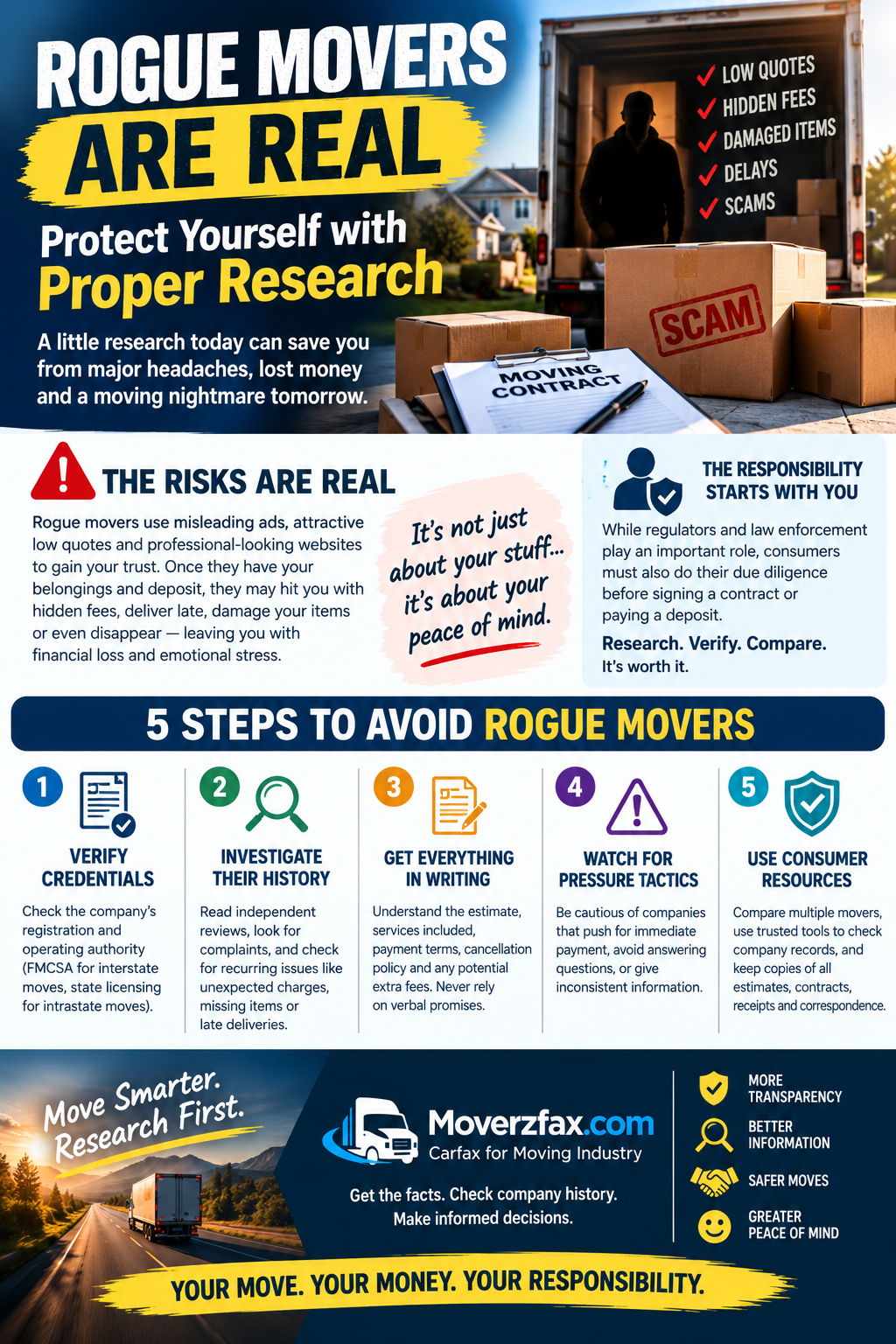
Hiring a moving company is a decision that deserves careful research. A low quote, a professional-looking website, or a friendly representative does not automatically mean you are dealing with a trustworthy business. Before handing over your belongings and your money, understand the risks and take responsibility for verifying who you hire.
The Responsibility Begins Before Moving Day
Moving is already a stressful experience. Whether you are relocating across town or across the country, you are trusting a company with possessions that may represent years of hard work, financial investment, and personal memories. Unfortunately, some operators take advantage of that trust through misleading estimates, unexpected charges, questionable business practices, or even outright fraud.
While regulators and law enforcement agencies have important roles in addressing rogue movers, consumers also have a critical responsibility: do your due diligence before signing a contract or paying a deposit.
No one can guarantee that a company will perform perfectly, but informed decisions can significantly reduce your exposure to avoidable risks. Assuming that every company advertising online is legitimate can turn an exciting new beginning into a costly and emotionally exhausting ordeal.
Why a Cheap Quote Can Become an Expensive Mistake
One common warning sign is a quote that seems dramatically lower than competing estimates. Some questionable operators may use an attractive initial price to secure a booking, only to demand substantially more money later. Others may provide vague estimates, fail to explain additional fees, or make promises that do not match the final contract.
Consumers can also encounter damaged or missing belongings, delayed deliveries, poor communication, and difficulties obtaining compensation when something goes wrong.
The consequences extend beyond financial losses. Families may experience anxiety, frustration, sleep disruption, and conflict when essential belongings fail to arrive on time. For someone moving because of a divorce, a new job, or another major life transition, these problems can intensify an already difficult period.
Taking time to investigate a mover is not an inconvenience. It is an investment in your financial security and peace of mind.
Five Steps Every Consumer Should Take
1. Verify credentials and registration. For interstate moves in the United States, check the company's registration and operating authority through the Federal Motor Carrier Safety Administration (FMCSA). For intrastate moves, verify applicable state licensing requirements. Remember that registration alone does not guarantee ethical conduct.
2. Investigate the company's history. Look beyond the company's own website. Review independent customer feedback, complaint patterns, business history, and available safety information. Pay particular attention to recurring allegations involving unexpected charges, missing belongings, or delivery problems.
3. Demand clear, written documentation. Understand the estimate, services included, payment terms, cancellation policies, and circumstances that could affect the final price. Never rely solely on verbal promises.
4. Be cautious of pressure tactics. Be wary of representatives who insist on immediate payment, avoid answering reasonable questions, provide inconsistent business information, or refuse to explain their terms clearly.
5. Use available consumer-protection resources. Compare multiple movers and use reputable tools that help you evaluate company records and past performance. Keep copies of estimates, contracts, receipts, correspondence, and inventories.
Don't Wait Until Something Goes Wrong
Many consumers begin investigating a moving company only after a dispute arises. By then, their belongings may already be in transit, their deposit may be gone, or their options may be limited.
The smarter approach is prevention.
That is where Moverzfax.com, a Carfax-style resource for the moving industry, aims to help consumers make more informed decisions by bringing attention to moving-company transparency and past performance. Research tools can support your decision, but they should complement—not replace—independent verification and careful review of contracts and credentials.
Your Move. Your Money. Your Responsibility.
You deserve to begin your next chapter with confidence, not uncertainty. Do not let a persuasive advertisement, an unusually low price, or a polished website replace proper research.
Before hiring a mover, ask questions, verify credentials, investigate complaints, and compare the available information. If something does not add up, take a step back.
The best time to discover a moving company has a troubling history is before it has your belongings.
Visit Moverzfax.com and make research part of your moving checklist. A few extra minutes of preparation today could help you avoid substantial financial losses, unnecessary stress, and a moving nightmare tomorrow.
Move smarter. Research first. Protect what matters.
Check Mover Legitimacy
Before hiring any mover, verify their USDOT registration and safety history report.
Search Mover Now