When Rogue Movers Hold Your Furniture Hostage: How to Protect Yourself From Moving Scams

Visual Infographic
Click on the image below to expand and view full size infographic.
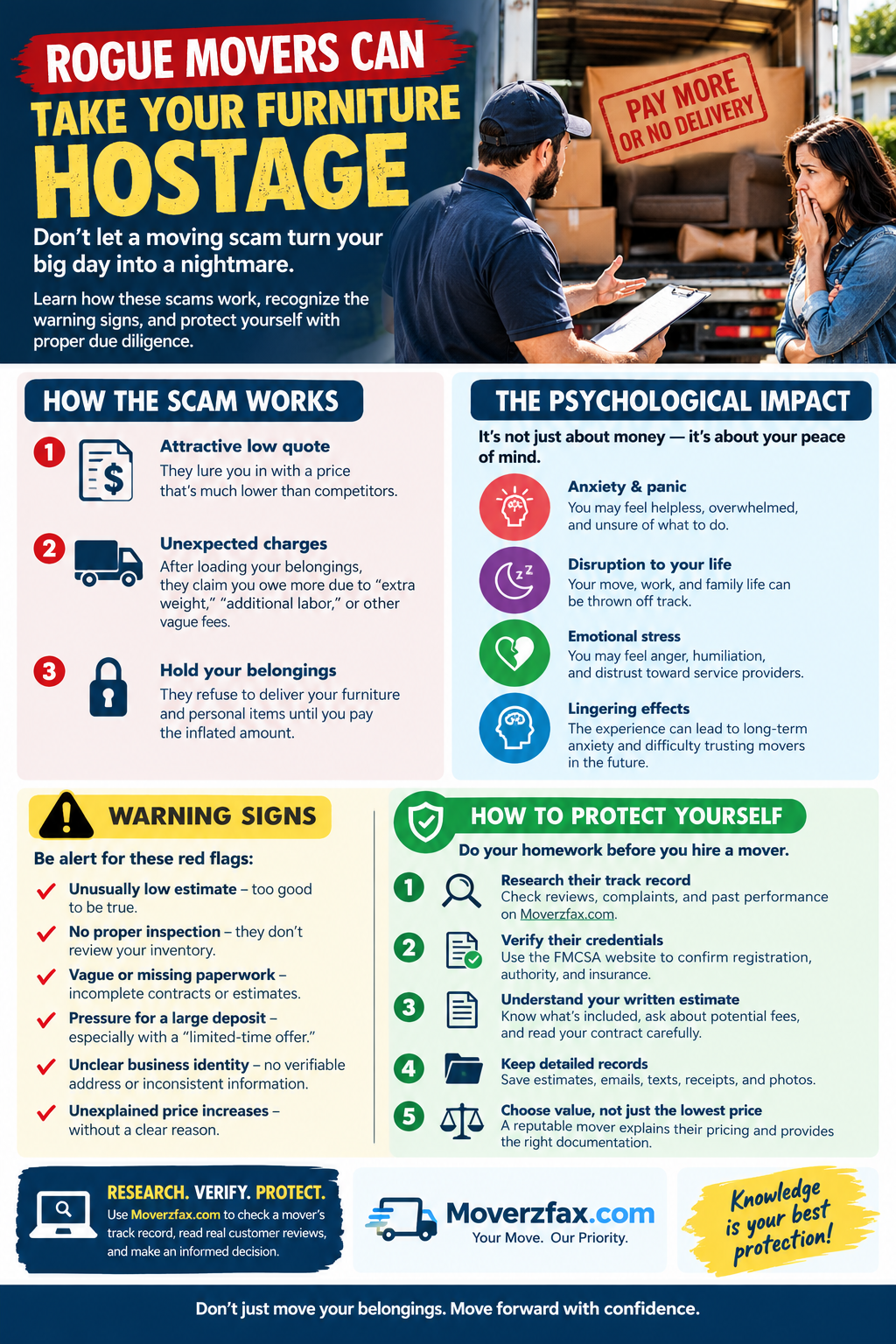
Imagine arriving at your new home after a long, exhausting moving day, only to discover that your moving company is demanding thousands of dollars more than the amount you originally agreed to pay. Your furniture, personal belongings, and cherished possessions are locked inside the moving truck, and the movers refuse to deliver them until you pay their newly inflated price.
Unfortunately, this is a scenario consumers should understand before hiring a moving company. Unscrupulous movers can exploit the stress and urgency of relocation by using unexpected charges and withholding delivery as leverage to pressure customers into paying more than they anticipated.
The good news is that education, careful planning, and thorough due diligence can help you reduce your risk of becoming a victim of a moving scam.
How the moving hostage scam works
The scheme often begins with an attractive quote that makes a moving company appear significantly cheaper than its competitors. Consumers naturally want to save money, especially when relocating involves deposits, travel expenses, rent, and other substantial costs.
After the customer books the move, the company may provide an estimate based on incomplete information, a quick phone conversation, or an insufficient assessment of the belongings being transported. Once the movers have loaded the furniture and personal possessions onto the truck, the situation can change dramatically.
The company may suddenly claim that the shipment weighs more than expected, that additional labor is required, or that stairs, long carries, packing materials, or other services justify a much higher charge. Some additional charges may be legitimate when properly disclosed and authorized. The warning sign is a substantial, unexplained price increase accompanied by pressure, intimidation, or a refusal to deliver the shipment unless the customer agrees to the new demand.
At this point, the customer faces an extremely difficult decision. Paying the inflated amount may strain their finances, but refusing to pay can leave them without access to essential belongings, including clothing, furniture, household supplies, and personal items they urgently need.
This imbalance of power is precisely what makes the scam so damaging.
The psychological impact on victims
Moving is already one of life's major transitions. People may be leaving behind familiar surroundings, starting a new job, moving closer to family, or beginning a new chapter after a difficult personal experience. They are often operating under tight deadlines and considerable emotional pressure.
When a mover unexpectedly demands additional money while withholding their possessions, the customer may experience panic, helplessness, anger, humiliation, and intense anxiety. The uncertainty surrounding the arrival of their belongings can disrupt sleep, strain family relationships, and interfere with work and everyday responsibilities.
Victims may also feel trapped because they fear that challenging the company will make the situation worse. Some pay money they cannot comfortably afford simply to regain access to their possessions. Others may experience lingering distrust toward service providers long after the incident has ended.
Understanding these tactics helps consumers recognize that a professional-looking website, a persuasive salesperson, or an unusually attractive quote does not necessarily guarantee trustworthy service.
Warning signs you should never ignore
The Federal Motor Carrier Safety Administration (FMCSA) identifies several warning signs consumers should watch for when hiring an interstate mover.
An unusually low estimate: A quote far below competitors may be designed to win your business before the price changes.
No proper inspection: The mover offers a quote without adequately reviewing your inventory, either in person or through a suitable virtual survey.
Vague or missing paperwork: You are not given a clear written estimate, or you are asked to sign incomplete documents.
Pressure to pay a large deposit: The company insists on immediate payment to secure a supposedly limited-time offer.
Unclear business identity: The company has no verifiable address, provides inconsistent business information, or cannot clearly explain its registration and operating authority.
Unexplained price increases: After loading your belongings, the company demands substantially more money without a satisfactory explanation.
One warning sign alone does not prove fraud. However, several warning signs together should prompt you to stop, investigate, and consider another mover before handing over your possessions.
How to protect yourself through due diligence
1. Research the mover's track record before booking
Do not base your decision solely on a company's website, advertisements, or sales representative. Investigate its business identity, operating history, consumer feedback, complaint patterns, and available regulatory records.
This is where Moverzfax.com can help consumers make more informed decisions. The platform is designed to help people research moving companies and examine information about their past performance before entrusting them with their household possessions.
Rather than waiting until a problem occurs, research the mover before signing a contract. Look for recurring complaints about unexpected charges, delivery delays, damaged or missing belongings, and demands for additional payment.
Remember that complaints are allegations, not automatically proven misconduct, and a lack of complaints does not guarantee that a company is trustworthy. Use multiple sources to develop a more complete picture.
2. Verify the company's registration and authority
For interstate moves, use the official FMCSA Protect Your Move website to verify the mover's registration, operating authority, insurance information, and available complaint history. Confirm that the company is authorized to transport household goods, rather than assuming that any registration is sufficient. For intrastate moves, also check the applicable state or local licensing requirements.
If you are working with a moving broker, ask which carrier will actually transport your belongings. Verify that carrier independently, too.
3. Understand your written estimate
Before moving day, request a detailed written estimate based on an accurate inventory of the items being moved and the services required.
Understand the difference between a binding estimate and a non-binding estimate. For qualifying interstate moves, federal rules generally limit what a mover can collect at delivery to 100% of a binding estimate or 110% of a non-binding estimate, subject to applicable exceptions and regulations. Certain additional charges may be handled separately.
Read your contract, inventory, bill of lading, and payment terms carefully. Ask questions about stairs, elevators, packing, bulky items, storage, shuttle services, and other potential charges before signing.
4. Keep records of every agreement
Save estimates, contracts, emails, text messages, receipts, inventory lists, and photographs of your belongings. Document any changes to the scope of the move and request revised written documentation when appropriate.
Having a clear record can help you challenge discrepancies and support a complaint if the company fails to honor its obligations.
5. Never confuse the lowest price with the best value
A reputable mover should be able to explain its pricing, identify the services included, and provide the required documentation. Compare several estimates, investigate the businesses behind them, and consider the quality of their records and communication.
Saving a few hundred dollars at booking is not a bargain if it exposes you to thousands of dollars in unexpected charges and the stress of trying to recover your possessions.
What should you do if your belongings are being held hostage?
If a mover refuses to deliver your belongings or demands an excessive payment, preserve all communications and payment records. Avoid threats or physical confrontation, and seek help from the appropriate authorities.
For interstate moves, contact the FMCSA at 1-888-368-7238 or submit a complaint through its
You may also contact your state attorney general or local law enforcement when appropriate. Federal protections may apply depending on the estimate, payment, and circumstances of the dispute.Do not assume you must pay any amount demanded simply to get your belongings back. Understand your contractual obligations and applicable protections, and seek official guidance promptly.
Make informed decisions. Protect your move.
Moving should be the beginning of a new chapter, not an experience that leaves you financially overwhelmed and emotionally exhausted. Yet consumers who skip their research may unknowingly place their possessions in the hands of companies whose business practices they have never examined.
At Moverzfax.com, our mission is to encourage greater transparency and informed decision-making in the moving industry. We believe consumers deserve access to useful information that helps them evaluate movers before making a commitment.
Before you hire a moving company, take the time to research its history, verify its credentials, compare estimates, and read the paperwork.
Visit Moverzfax.com as part of your due diligence process and use the resources available to help you make a more informed choice.
Your furniture, your savings, and your peace of mind are too valuable to leave to chance. Research before you relocate. Verify before you sign. Protect yourself before your belongings leave your home.
Check Mover Legitimacy
Before hiring any mover, verify their USDOT registration and safety history report.
Search Mover NowRecent Articles














No comments published yet. Be the first to share your thoughts below!
Leave a Reply