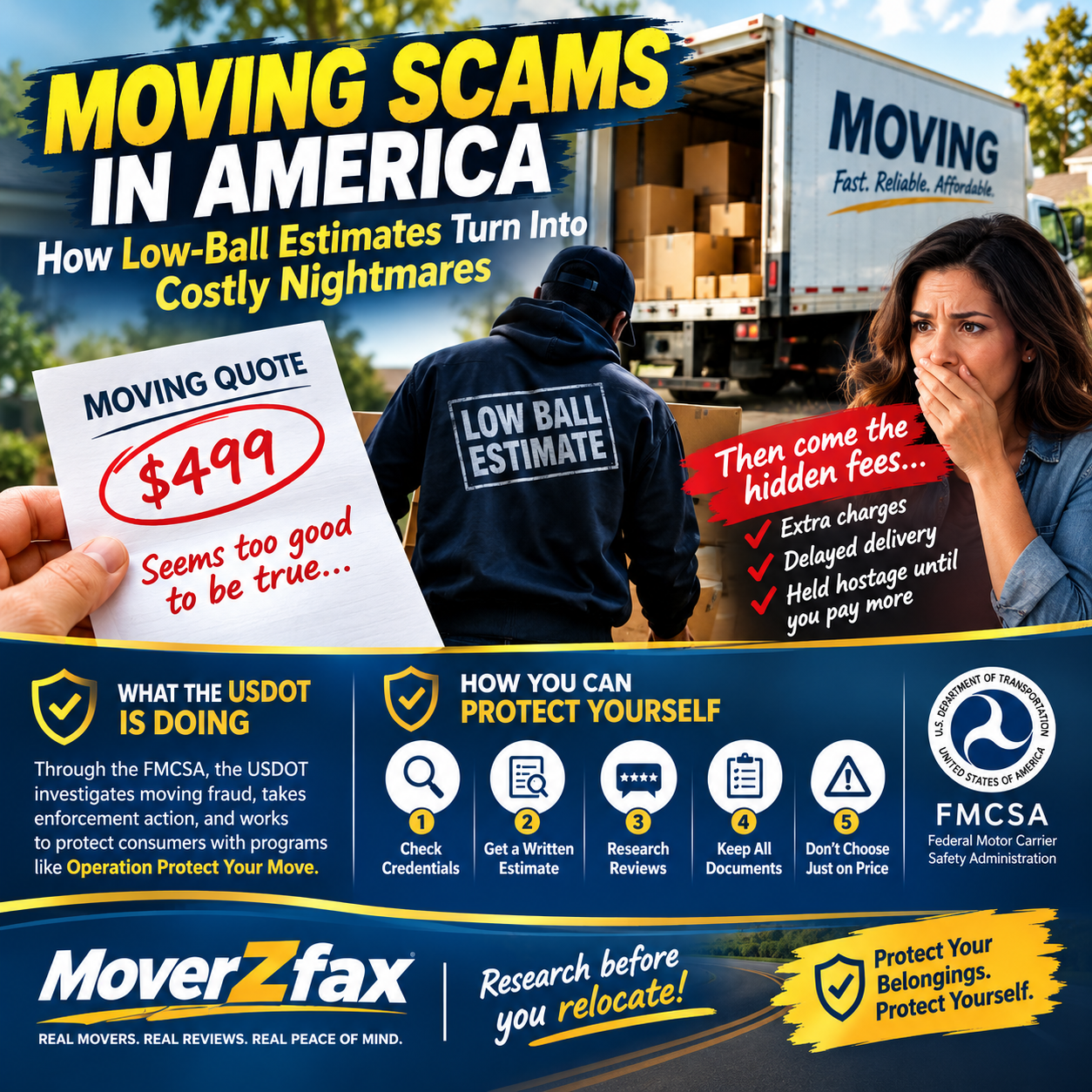
Moving Scams in America: How Low-Ball Estimates Turn Into Costly Nightmares
Visual Infographic
Click on the image below to expand and view full size infographic.
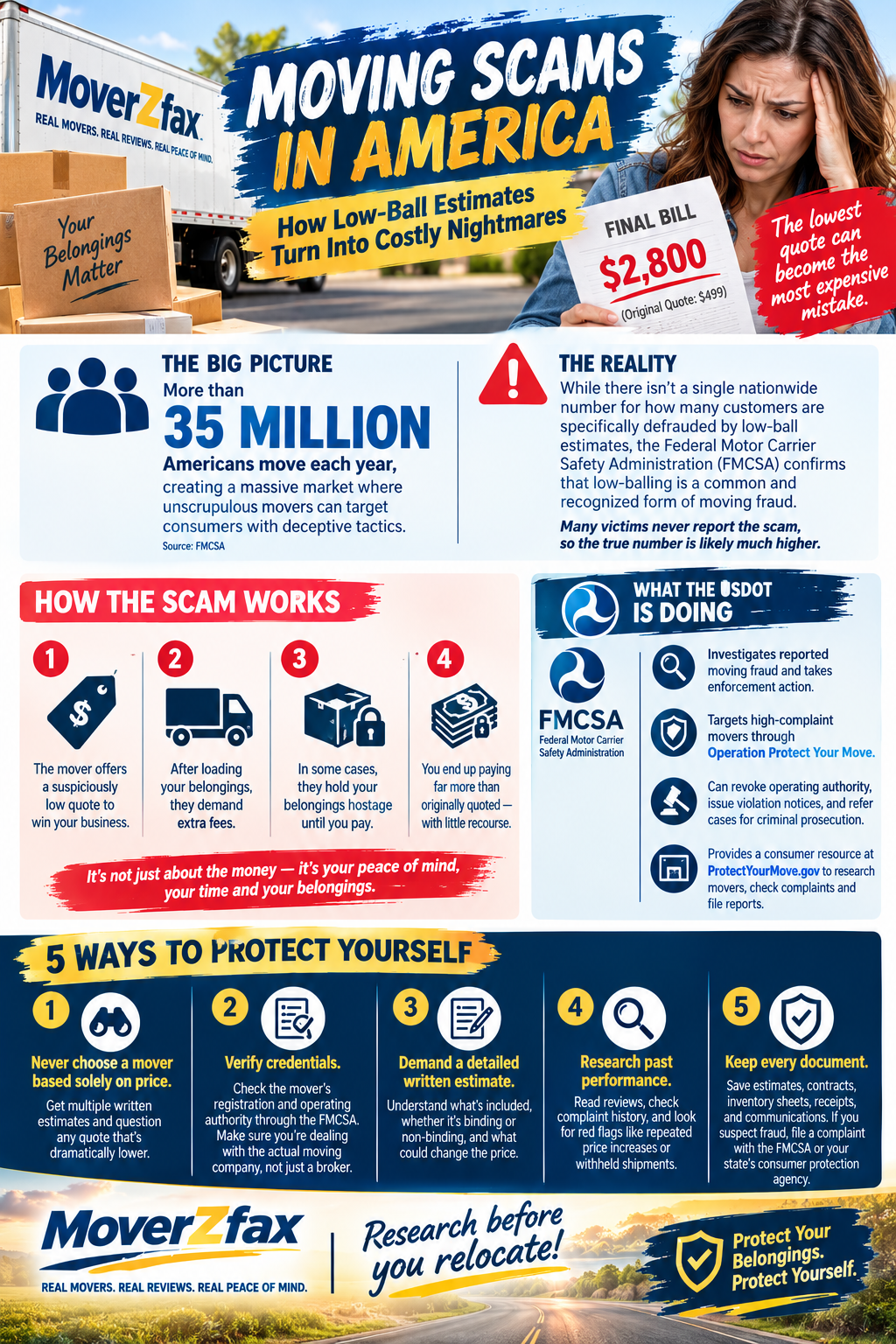
The lowest moving quote can become the most expensive mistake. Every year, consumers searching for affordable movers risk falling victim to deceptive estimates, unexpected fees, and companies that refuse to release their belongings until additional payments are made. Understanding how these schemes work—and how federal authorities respond—can help protect your property, finances, and peace of mind.
How Many Customers Are Being Ripped Off?
The Federal Motor Carrier Safety Administration (FMCSA), part of the U.S. Department of Transportation (USDOT), identifies deliberately low-balling estimates as a recognized form of moving fraud. Rogue movers may offer an unusually low price to secure a booking, then dramatically increase the cost after loading the customer's possessions. In some cases, they threaten to withhold the shipment until the customer pays.
Although the FMCSA tracks complaints involving interstate moving companies and brokers, there is no single verified national figure that establishes exactly how many customers are defrauded annually specifically through low-ball estimates. Official complaint totals also cannot capture every incident, because some victims never report what happened.
The scale of the problem is nevertheless serious. The FMCSA reports that more than 35 million Americans move each year, creating a substantial market in which dishonest operators can target consumers who are under pressure to relocate.
What Is the USDOT Doing to Protect Consumers?
Through the FMCSA, the USDOT investigates reported moving fraud and takes enforcement action when warranted. Its Operation Protect Your Move initiative targets moving companies and brokers with serious complaint histories and alleged violations of federal consumer-protection and safety requirements.
During enforcement operations in 2023, the agency identified more than 1,000 regulatory violations. Its 2024 operation also targeted reports involving movers holding household goods hostage for exorbitant additional payments. Depending on the findings, enforcement can include formal violation notices, revocation of operating authority, and referrals for possible criminal prosecution.
The FMCSA also provides a public resource, ProtectYourMove.gov, where consumers can research interstate movers, review available complaint and safety information, understand their rights, and report suspected fraud.
However, government oversight cannot guarantee that every dishonest company will be identified before a customer hires it. Consumer due diligence remains essential.
Five Ways to Protect Yourself From Rogue Movers
1. Never choose a mover based solely on price. Obtain multiple written estimates and question any quote that is dramatically lower than competing offers. A suspiciously low price may be a sales tactic rather than a realistic assessment of your move.
2. Verify credentials. For interstate moves, check the mover's registration and operating authority through the FMCSA. Confirm whether you are dealing with the actual moving company or a broker arranging transportation through another provider.
3. Demand a detailed written estimate. A proper estimate should account for the belongings being moved and the services required. Understand whether it is binding or non-binding and what circumstances could change the price. For interstate moves, federal rules generally limit the amount a mover may require at delivery under a non-binding estimate to 110% of that estimate, with qualifying additional charges handled under applicable rules.
4. Research past performance. Read reviews critically, look for recurring complaints about price increases or withheld possessions, and examine the company's complaint history. Do not rely exclusively on testimonials published on the mover's own website.
5. Keep every document. Save estimates, contracts, inventory sheets, receipts, emails, text messages, and photographs. If you suspect interstate moving fraud, file a complaint with the FMCSA and provide supporting documentation. For an intrastate move, contact the appropriate state consumer-protection or enforcement agency.
MoverZfax: Research Before You Relocate
At MoverZfax.com, our mission is to help consumers make more informed moving decisions by encouraging transparency, accountability, and research into a mover's history. Use available information to evaluate a company's credentials, reputation, and past performance before entrusting it with your household possessions.
Remember: the cheapest quote is not always the best deal. A little research today can help prevent unexpected expenses, unnecessary stress, and the devastating experience of having your belongings held hostage tomorrow.
MoverZfax — Real Movers. Real Reviews. Real Peace of Mind.
Check Mover Legitimacy
Before hiring any mover, verify their USDOT registration and safety history report.
Search Mover Now